Framework
The DACR Framework.
The David Akpan's Community Mobilization, Monitoring and Reporting Framework: a step-by-step, interconnected guide for meaningful and sustainable community work. SMART CoMM-R is its digital toolkit.
At a glance
The Community Sits at the Centre.
A structured, organized and standard framework that provides a step-by-step interconnected guide for meaningful and sustainable community mobilization, monitoring and reporting of program interventions spanning health, education, food security, livelihood, peacebuilding and more.
It serves as an operational blueprint for frontline workers, community mobilizers, supervisors, program managers, government stakeholders and partners, to ensure that community-focused programs are implemented in a result-oriented and sustainable manner.
Three components
Mobilize, Monitor, Report.
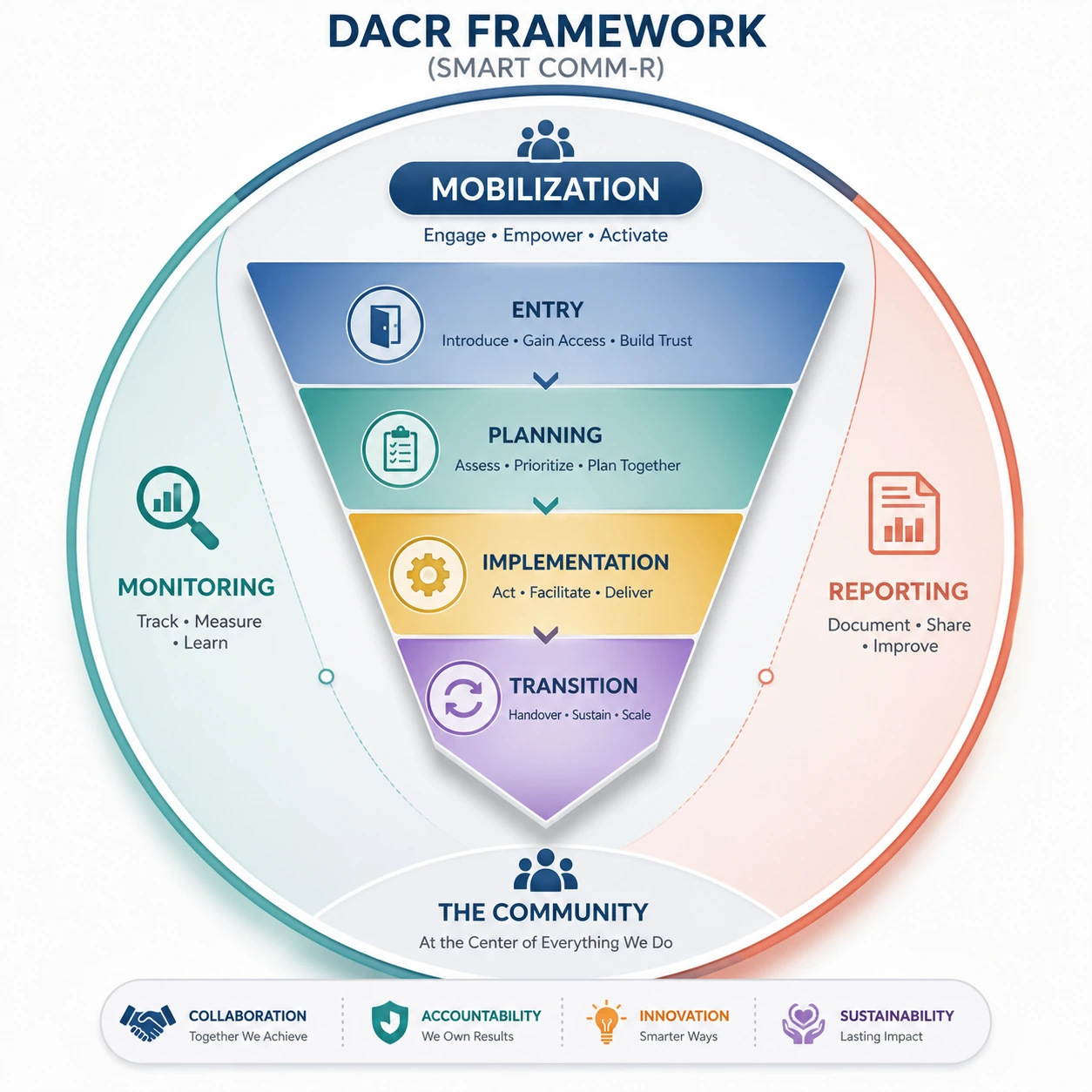
The framework is built around three interconnected components.
Mobilization
Engage · Empower · Activate
Outlines a standard process and protocol for engaging, strengthening and empowering communities, their stakeholders and structures, using standard tools and approaches to enhance participation and promote ownership and sustainability.
Monitoring
Track · Measure · Learn
Outlines approaches and standards focused on tracking activities, measuring performance, and learning from real-time field data.
Reporting
Document · Share · Improve
Outlines approaches and standards that support the process, documentation, analysis, sharing, and continuous improvement of program activities and outcomes.
The implementation path
Four Phases, One Path.
Each phase is enriched with a set of SMART tools that can be used independently or together across the phases, depending on the need and focus of the program.
- Phase 1
Entry
Introduce · Gain Access · Build TrustProgram teams engage key community stakeholders for program buy-in, participation, ownership and support, using a set of standard tools.
- Phase 2
Planning
Assess · Prioritize · Plan TogetherIdentifying target communities, mapping households, setting mobilization targets, selecting communication channels, and preparing work plans while adhering to standard protocols and tools.
- Phase 3
Implementation
Act · Facilitate · DeliverPrevention and response activities (household visits, community meetings, sensitization sessions, demand-generation activities and other community engagement interventions), supported by real-time data collection and reporting.
- Phase 4
Transition
Handover · Sustain · ScalePerformance review, documentation of lessons learned, feedback collection, and the handover of responsibilities to local structures where appropriate.
Collaboration
Together we achieve
Accountability
We own results
Innovation
Smarter ways
Sustainability
Lasting impact
What SMART CoMM-R adds
The Framework, on the Phone and the Web.
SMART CoMM-R integrates digital tools, GIS-enabled monitoring, standardized indicators, supervision checklists and reporting dashboards. Program managers can track field activities in real time, spot implementation gaps quickly, and make evidence-based decisions.
Theory of change
Ifa user-friendly, acceptable SMART CoMM-R equipped with a GIS-enabled toolkit is used to plan, implement, monitor and report polio programs,
Andit is used more effectively and consistently, with minimal support and accountability,
Thenwe will have improved (higher quality) community mobilization, increased vaccine uptake and reduced zero-dose children in Nigeria.
- Outputs
- Change in the internal systems, skills and approaches for mobilization, monitoring and reporting using SMART tools.
- Outcomes
- Improved effectiveness, efficiency, quality, performance and uptake of vaccines.
- Impact
- Improved health and reduced zero-dose in Nigeria.